


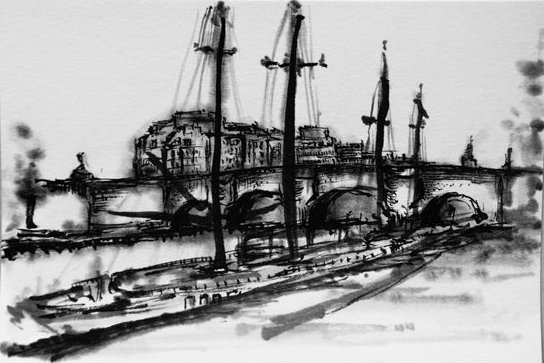

いつものハガキサイズの画仙紙に墨だけで、
アンコールワット、タイ寺院、フランス街の景色、中国の景色
細い線から塗っていく方法。
最初から滲みだけの方法。
細い線だけの方法。
試行錯誤中

 By the Last Supper is meant the final meal that Jesus shared with his twelve disciples before his death. The events of that evening are recounted in the canonical gospels and by the Paul the Apostle. According to what Paul wrote in his First Letter to the Corinthians, at that meal Jesus gave his disciples bread, saying it was his body, which was broken for them, and gave them wine, saying it was the new covenant in his blood, and told them to do it in his memory.
 ダビンチ作の最後の晩餐(掛け軸サイズ)
 Tower Bridge is a combined bascule and suspension bridge in London, England, over the River Thames. It is close to the Tower of London, which gives it its name.Name It has become an iconic symbol of London.
 ロンドンタワーブリッジ
 ロンドンタワーブリッジと町並み(掛け軸サイズ)


 The Sultan Ahmed Mosque (Turkish: Sultanahmet Camii) is a historical mosque in Istanbul, the largest city in Turkey and the capital of the Ottoman Empire (from 1453 to 1923). The mosque is popularly known as the Blue Mosque for the blue tiles adorning the walls of its interior.
 イスタンブールとブルーモスク(スルタンアフメト・モスク)
 Kiyomizu-dera (清水寺), officially Otowa-san Kiyomizu-dera (音羽山清水寺) is an independent Buddhist temple in eastern Kyoto. The temple is part of the Historic Monuments of Ancient Kyoto (Kyoto, Uji and Otsu Cities) UNESCO World Heritage sit
 清水寺
清水寺 山の景色
山の景色 The kimono (着物) is a Japanese traditional garment worn by women, men and children. The word "kimono", which literally means a "thing to wear" (ki "wear" and mono "thing"), has come to denote these full-length robes. The standard plural of the word kimono in English is kimonos,
 着物女性
着物女性 花と寺
花と寺 A "Thangka," also known as "Tangka", "Thanka" or "Tanka" is a Tibetan silk painting with embroidery, usually depicting a Buddhist deity, famous scene, or mandala of some sort. The thankga is not a flat creation like an oil or acrylic painting. Rather, it consists of a picture panel which is painted or embroidered, over which a textile is mounted, and then over which is laid a cover, usually silk. Generally, thankgas last a very long time and retain much of their lustre, but because of their delicate nature, they have to be kept in dry places where moisture won't affect the quality of the silk. It is sometimes called a scroll-painting.
 タンカ(仏画)
 エッフェル塔
 Notre Dame de Paris ( Our Lady of Paris)
 Île de la Cité (Cite island)
 シテ島( Île de la Cité)
 The Musée d'Orsay is a museum in Paris, France, on the left bank of the Seine, housed in the former railway station, the Gare d'Orsay, an impressive Beaux-Arts edifice built between 1898 and 1900. It holds mainly French art dating from 1848 to 1915, including paintings, sculptures, furniture, and photography, and is probably best known for its extensive collection of impressionist and post-impressionist masterpieces (the largest in the world) by such painters such as Monet, Manet, Degas, Renoir, Cézanne, Seurat, Gauguin and Van Gogh. Many of these works were held at the Galerie nationale du Jeu de Paume prior to the museum's opening in 1986.
 オルセー美術館 (Musée d'Orsay)
 Pont Alexandre III is an arch bridge that spans the Seine, connecting the Champs-Élysées quarter and the Invalides and Eiffel Tower quarter, widely regarded as the most ornate, extravagant bridge in Paris


 Mont Saint-Michel (English: Saint Michael's Mount)

 10年前に初めて描いたアンコールワット


